
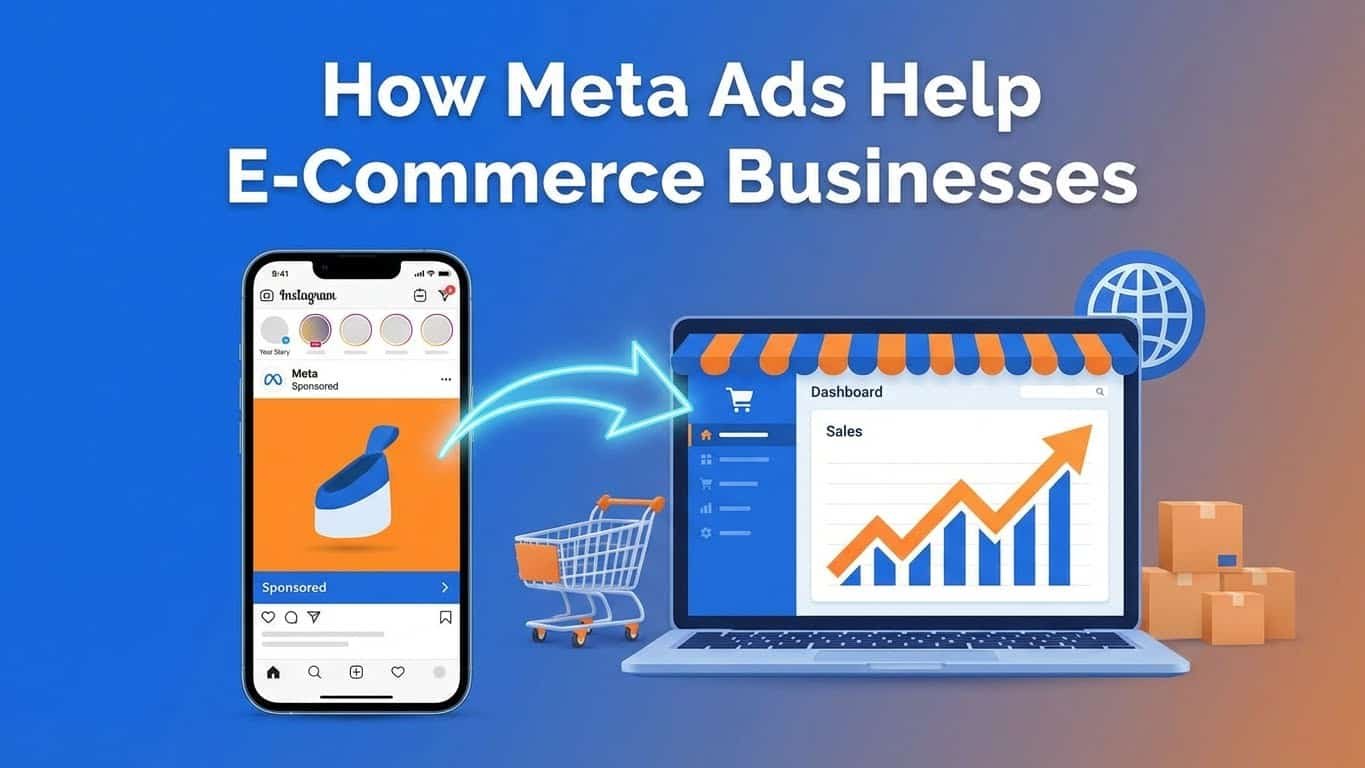
How Meta Ads Help E-Commerce Businesses
The e-commerce landscape has expanded rapidly in recent years, with global online retail sales surpassing $5 trillion and no signs of slowing. However, this growth has also brought unprecedented competition. Thousands of new online stores launch every day, making it increasingly difficult for businesses to stand out and attract customers organically.
In this crowded marketplace, paid advertising has become essential for scaling online stores. While organic reach through social media and SEO remains valuable, it’s often too slow and unpredictable for businesses looking to grow quickly. This is where Meta Ads becomes a game-changing solution.
Meta Ads encompasses the advertising platforms across Facebook, Instagram, Messenger, and the Audience Network, reaching billions of users worldwide with sophisticated targeting capabilities. For e-commerce businesses, Meta Ads offer an unparalleled opportunity to connect with potential customers at every stage of their buying journey, from initial discovery to final purchase and beyond.
In this comprehensive guide, we’ll explore why Meta Ads have become the go-to advertising platform for e-commerce brands, how they drive sales, which tools and ad formats work best, and how to optimize your campaigns for maximum return on investment. Whether you’re just starting out or looking to scale your existing advertising efforts, understanding how to leverage Meta’s advertising ecosystem can be the difference between struggling to break even and building a thriving online business.
What Are Meta Ads?
Meta Ads is the umbrella term for the advertising platform that allows businesses to promote their products and services across Meta’s family of apps and services. When you run a Meta Ad campaign, you’re tapping into an interconnected ecosystem that includes Facebook, Instagram, Messenger, and the Audience Network.
Facebook remains the largest social media platform globally, with a diverse user base spanning age groups, interests, and locations. It’s particularly effective for detailed targeting and community-building campaigns. Instagram has become the visual shopping destination, especially popular with younger audiences and perfect for lifestyle and aspirational product marketing. Messenger allows businesses to create conversational ads that drive direct engagement, while the Audience Network extends your reach beyond Meta’s owned properties to third-party apps and websites.
What makes Meta’s advertising ecosystem unique is its unified approach. You create campaigns in one place using Meta Ads Manager (formerly Facebook Ads Manager), and Meta’s algorithm distributes your ads across platforms where they’re most likely to perform well. The system uses advanced machine learning to optimize ad delivery based on your objectives, whether that’s driving website traffic, generating sales, or building brand awareness.
For e-commerce brands, Meta Ads provides access to one of the most sophisticated advertising platforms ever created. The combination of massive reach, granular targeting options, and powerful optimization tools makes it possible for businesses of any size to compete effectively and grow profitably.
Why Meta Ads Are So Effective for E-Commerce
1. Highly Advanced Targeting Options
Meta’s targeting capabilities are among the most sophisticated in digital advertising. You can reach potential customers based on their interests, behaviors, demographics, and location with remarkable precision. Whether you’re selling fitness equipment and want to target gym enthusiasts, or selling baby products and want to reach new parents, Meta’s interest-based targeting makes it possible.
Beyond basic targeting, Meta Pixel (a piece of code installed on your website) enables retargeting of website visitors. This means you can show ads specifically to people who visited your product pages, added items to their cart, or even completed a purchase. This behavioral data creates incredibly warm audiences who are already familiar with your brand.
Lookalike audiences take targeting even further by allowing Meta to find new customers who share similar characteristics with your best existing customers. By analyzing patterns in your customer base, Meta can identify and reach people who are statistically likely to be interested in your products, effectively helping you scale your customer acquisition efforts.
2. Massive Global User Base
With over 3 billion monthly active users across its platforms, Meta provides access to an audience that’s simply unmatched. Nearly half of the world’s population uses at least one Meta platform regularly, which means your potential customers are almost certainly there.
This massive reach is ideal for both acquiring new customers and staying top-of-mind with returning ones. Whether you’re targeting a local market or expanding internationally, Meta’s global infrastructure makes it possible to reach your audience wherever they are. The platform’s ubiquity also means you can follow your customers throughout their day as they switch between scrolling Facebook during breakfast, checking Instagram stories during lunch, and browsing Reels in the evening.
3. Visual & Creative Ad Formats
E-commerce is inherently visual. Customers need to see products to desire them, and Meta’s advertising platform is built around visual content that drives purchase intent. The platform offers multiple ad formats specifically designed for e-commerce success.
Image ads are straightforward and effective for showcasing individual products with clean, professional photography. Carousel ads allow you to display multiple products or highlight different features of a single product, with users swiping through up to 10 images or videos. Video ads excel at storytelling, demonstrating product use, or creating emotional connections with your brand.
Collection ads create an immersive mobile storefront experience, allowing customers to browse your products without leaving the Meta platform. Reels ads tap into the short-form video trend, perfect for engaging younger audiences with entertaining, authentic content that doesn’t feel like traditional advertising.
These visual formats naturally align with how people shop online. They allow customers to see products in context, understand their benefits, and imagine themselves using them, all of which drives higher conversion rates compared to text-heavy advertising formats.
4. Strong Retargeting Capabilities
One of Meta Ads’ most powerful features for e-commerce is its retargeting capability. Studies show that only 2-3% of website visitors convert on their first visit. The remaining 97% need additional touchpoints before making a purchase decision.
Meta’s retargeting tools allow you to re-engage these visitors with tailored messaging. You can create specific audiences for people who viewed product pages but didn’t add to cart, those who abandoned their carts, or even past purchasers you want to upsell to. Each audience can receive customized ads that address their specific stage in the buying journey.
Dynamic remarketing takes this even further through Dynamic Product Ads (DPA). These ads automatically show people the exact products they viewed on your website, along with related items they might like. This level of personalization significantly increases the likelihood of conversion, as customers are reminded of products they’ve already shown interest in.
5. Cost-Effective Compared to Many Platforms
Meta Ads offer exceptional value for e-commerce businesses, especially when properly optimized. The platform operates on an auction-based system where you compete with other advertisers for ad space, but you maintain complete control over your budget. You can start with as little as $5 per day and scale up as you see results.
The cost structures are flexible. You can pay per thousand impressions (CPM), per click (CPC), or per action taken (CPA), depending on your campaign objectives. This flexibility allows you to align your spending with your business goals and optimize for what matters most.
With proper audience targeting, compelling creatives, and optimized landing pages, many e-commerce businesses achieve return on ad spend (ROAS) of 3:1 to 10:1 or higher. This means for every dollar spent on ads, they’re generating three to ten dollars in revenue. Few advertising platforms can match this combination of reach, targeting precision, and cost-effectiveness.
How Meta Ads Drive Sales for E-Commerce Stores
1. Increases Product Visibility
The first step in making a sale is getting your products in front of potential customers. Meta Ads excel at creating awareness among people who have never heard of your brand. Through strategic targeting, you can reach audiences who match your ideal customer profile but haven’t yet discovered your products.
This visibility is particularly valuable for new product launches and seasonal campaigns. When you release a new collection or run a holiday promotion, Meta Ads can quickly spread the word to thousands or millions of relevant users. The platform’s algorithm learns which audiences respond best to your products and automatically optimizes delivery to maximize visibility among high-intent users.
2. Boosts Website Traffic
Meta Ads are highly effective at driving qualified traffic to your online store. Unlike random visitors who stumble upon your site, traffic from Meta Ads consists of people who saw your product, found it appealing, and actively chose to learn more. This intent-driven traffic converts at higher rates than most other sources.
Additionally, every visitor you drive to your website becomes part of your retargeting pool (when tracked via Meta Pixel). This means even if they don’t purchase immediately, you’ve now captured them in an audience you can continue marketing to. The more quality traffic you drive, the larger and more valuable your retargeting audiences become.
3. Improves Conversion Rate
Meta’s personalization capabilities directly impact conversion rates. By showing relevant products to relevant people at relevant times, the platform increases the likelihood of purchase. Someone who recently searched for running shoes on Google and engages with fitness content on Instagram is far more likely to buy your athletic footwear than a random internet user.
Dynamic ads enhance this further by displaying products based on individual browsing behavior. When someone sees an ad featuring the exact sneakers they looked at on your site yesterday, along with a limited-time discount code, the personalized approach dramatically increases conversion probability. This one-to-one marketing at scale is what makes Meta Ads so powerful for e-commerce.
4. Helps Sell Across the Entire Marketing Funnel
The customer journey from awareness to purchase rarely happens in a single interaction. Meta Ads allow you to guide potential customers through each stage of the funnel with appropriate messaging for each phase.
At the awareness stage, you might run broad-reaching campaigns showcasing your brand story or best-selling products to cold audiences. These ads focus on capturing attention and generating interest. At the consideration stage, you retarget people who engaged with your initial ads or visited your website, providing more detailed product information, customer testimonials, or comparisons that help them evaluate your offering.
Finally, at the conversion stage, you deploy highly targeted ads to warm audiences with compelling offers, urgency-driven messaging, or reminders about abandoned carts. This multi-touch approach, where a customer sees your first ad introducing the brand, then a retargeting ad highlighting a specific product, and finally a reminder ad with a discount code, is far more effective than hoping for immediate sales from cold traffic.
5. Builds Long-Term Brand Recognition
Beyond immediate sales, Meta Ads contribute to long-term brand building. Repeated exposure to your brand across Facebook and Instagram creates familiarity, which builds trust over time. Even people who don’t click on your ads initially are absorbing your brand identity, product offerings, and value proposition.
This accumulated brand awareness pays dividends down the line. When these users finally need a product you sell, your brand will come to mind first because they’ve seen it consistently in their feeds. This top-of-mind awareness is invaluable in competitive markets where multiple brands offer similar products. The brand that’s most familiar often wins the sale.
Key Meta Ad Tools That Help E-Commerce Businesses
Facebook Pixel is the foundation of effective Meta advertising for e-commerce. This small piece of code installed on your website tracks visitor actions, allowing you to measure campaign performance, build custom audiences, and optimize ad delivery. Without the Pixel, you’re essentially advertising blind, unable to retarget visitors or accurately attribute sales to your ads.
Conversions API (CAPI) works alongside the Pixel to improve tracking accuracy, especially as browser privacy features and iOS changes have made cookie-based tracking less reliable. CAPI sends conversion data directly from your server to Meta, creating a more complete picture of customer behavior and improving attribution accuracy.
Advantage+ Shopping Campaigns (formerly Dynamic Ads) leverage Meta’s machine learning to automate campaign optimization. These campaigns automatically test different audience segments, placements, and creative combinations to find the highest-performing combinations, reducing the manual work required while often delivering better results than traditional manual campaigns.
Catalog Manager allows you to upload your entire product inventory to Meta, creating a feed that powers Dynamic Product Ads. Once set up, it automatically keeps your product information, pricing, and availability updated, enabling you to show personalized product recommendations to potential customers at scale.
Custom Audiences let you target specific groups based on their interactions with your business. You can create audiences from customer email lists, website visitors, app users, or people who engaged with your content on Meta platforms. These warm audiences typically convert at much higher rates than cold traffic.
Lookalike Audiences use your best customers as a template to find new people with similar characteristics. By analyzing demographics, interests, and behaviors of your existing customers, Meta identifies other users likely to be interested in your products, providing a scalable way to expand beyond your known audience.
A/B Testing tools within Meta Ads Manager allow you to scientifically test different variables in your campaigns. You can test creative variations, audience segments, placement strategies, or landing pages to identify what drives the best results. This data-driven approach removes guesswork and continuously improves campaign performance over time.
Best Performing Meta Ad Types for E-Commerce
Dynamic Product Ads (DPA) consistently rank among the highest-performing ad types for e-commerce. These ads automatically promote relevant products to people who have expressed interest on your website, in your app, or elsewhere on the internet. They work by matching products from your catalog with potential customers based on their browsing behavior, creating highly personalized ads without manual effort.
Carousel Ads are excellent for showcasing product variations, multiple products from a collection, or highlighting different features of a single product. Each card in the carousel can link to a different product page, allowing you to maximize the value of a single ad placement. They’re particularly effective for fashion retailers showing different colorways or tech companies displaying product specifications.
Collection Ads create an immersive mobile shopping experience that bridges the gap between discovery and purchase. They feature a cover image or video followed by several product images in a grid layout below. When users tap the ad, they’re taken to an Instant Experience (formerly Canvas), a fast-loading, full-screen mobile experience where they can browse products without leaving Meta’s platform. This seamless experience reduces friction and increases conversion rates.
Video Ads excel at storytelling and demonstrating product value in ways static images cannot. Whether it’s showing a product in use, explaining its benefits, or creating an emotional connection through brand storytelling, video captures attention and communicates more information in less time. Increasingly, short-form video content performs particularly well as users’ content consumption habits shift.
Reels Ads have emerged as a powerful format for reaching younger audiences and capitalizing on the short-form video trend. These full-screen vertical videos appear between organic Reels content, offering high engagement rates when done well. The key is creating content that feels native to the platform—authentic, entertaining, and less overtly promotional than traditional ads.
Lead Ads serve a different purpose, focusing on customer acquisition for pre-launches, waitlists, or building an email database. While not directly driving immediate sales, they capture contact information from interested users with minimal friction, as forms auto-populate with users’ Facebook information. These leads can then be nurtured through email marketing toward eventual purchase.
How to Optimize Meta Ads for Maximum ROI
Strong Creatives are the foundation of successful Meta advertising. Your ad creative is what stops users from scrolling and captures their attention. User-generated content (UGC) showing real customers using your products, lifestyle imagery that helps viewers imagine the product in their lives, and product demonstration videos tend to outperform generic stock photography. The creative should clearly showcase your product’s benefits and stand out in the feed.
Clear Calls-to-Action guide users toward the desired action. Whether it’s “Shop Now,” “Learn More,” or “Get 20% Off,” your CTA should be specific, action-oriented, and create a sense of urgency or value. Vague CTAs like “Click Here” underperform compared to benefit-driven language that tells users exactly what they’ll get.
Audience Segmentation prevents wasting budget on irrelevant users while ensuring your message resonates with those who see it. Create separate campaigns or ad sets for cold audiences (people unfamiliar with your brand), warm audiences (website visitors, social media engagers), and hot audiences (cart abandoners, past purchasers). Each segment should receive messaging appropriate to their familiarity with your brand and their position in the buying journey.
Conversion-Focused Landing Pages are critical because sending traffic to poorly designed pages wastes your ad spend. Your landing page should load quickly, match the messaging and aesthetic of your ad, highlight product benefits clearly, include social proof like reviews, and make the purchase process as frictionless as possible. A great ad with a poor landing page will fail, while a good ad with an excellent landing page can succeed.
Retargeting Funnel Setup ensures you’re maximizing the value of every website visitor. Create a structured funnel with different ad messages for different stages: general retargeting for all visitors, specific product retargeting for those who viewed particular items, cart abandonment campaigns with urgency or incentives, and post-purchase campaigns for cross-sells or repeat purchases. This sequential approach nurtures prospects toward conversion.
Daily Monitoring and Scaling Strategy determines your long-term success. Check your campaigns daily, particularly in the first few days, to ensure they’re delivering as expected. When you find winning campaigns, scale them carefully. Horizontal scaling (duplicating successful ad sets with new audiences or creatives) is generally safer than vertical scaling (increasing budgets), which can disrupt the algorithm’s learning. Increase budgets gradually, typically no more than 20-30% every few days, to maintain performance while growing spend.
Common Mistakes E-Commerce Brands Make With Meta Ads
Targeting Too Broadly or Too Narrowly represents one of the most frequent errors. Targeting everyone in a country might seem like maximizing reach, but it dilutes your message and wastes budget on uninterested users. Conversely, over-narrowing your audience by stacking too many interests can limit your reach so severely that campaigns never exit the learning phase. The sweet spot varies by product and budget, but generally, aim for audiences of at least 500,000 for cold prospecting campaigns.
Poor Creative Quality will doom even the best-targeted campaign. Blurry product photos, amateurish graphics, or videos with poor lighting and sound fail to inspire confidence in your brand. In a visual medium where you’re competing for attention against professionally produced content, subpar creatives get ignored. Invest in quality photography, videography, and graphic design, or use UGC that feels authentic and relatable.
Sending Ads to Slow or Unoptimized Websites creates a disconnect that kills conversions. You’ve paid to drive traffic to your site, but if pages take more than three seconds to load, most users will bounce before seeing your products. Similarly, websites that aren’t mobile-optimized, have confusing navigation, lack clear product information, or have complicated checkout processes will convert poorly regardless of how good your ads are.
Not Using Pixel/CAPI means flying blind. Without proper tracking implementation, you can’t accurately measure which campaigns are profitable, can’t build retargeting audiences, and can’t leverage Meta’s conversion optimization. Yet surprisingly many businesses either don’t install the Pixel, install it incorrectly, or fail to implement the Conversions API to improve data accuracy. This fundamental setup is non-negotiable for serious e-commerce advertising.
Lack of Retargeting Funnel leaves money on the table. Most businesses focus exclusively on acquiring new customers while ignoring the 97% who visit but don’t buy. Since retargeting campaigns typically achieve 3-10x better ROAS than cold prospecting, failing to implement a sophisticated retargeting strategy means missing out on your most profitable opportunities.
Setting Unrealistic Budgets creates either disappointment or inefficiency. Starting with $5 per day across multiple campaigns doesn’t give any single campaign enough data to optimize effectively. Meta’s algorithm needs sufficient budget and volume to learn what works. Conversely, throwing thousands of dollars at campaigns before testing and validating profitable approaches risks significant losses. Start with enough budget for campaigns to exit the learning phase (roughly 50 conversions per week per ad set), validate profitability at small scale, then increase investment in proven winners.
Real-World Results: What’s Possible With Meta Ads
Consider the case of a mid-sized fashion accessories brand that was generating $50,000 monthly revenue through organic social media and word-of-mouth. They had a decent product and strong reviews but couldn’t break through the growth ceiling.
After implementing a strategic Meta Ads approach, their results transformed. They started with a modest $1,500 monthly ad budget, focusing on carousel ads showcasing their bestselling products to interest-based audiences. Within the first month, they generated $6,000 in attributed revenue, achieving a 4:1 ROAS.
More importantly, they began building their retargeting audiences. By month three, with the same total budget now split between cold prospecting and retargeting, their ROAS improved to 5.5:1. They reinvested profits back into advertising, gradually scaling to $5,000 monthly ad spend while maintaining a 4.8:1 ROAS. Within six months, monthly revenue had grown to $180,000, with approximately 70% of that growth directly attributable to Meta Ads.
The transformation wasn’t just about the immediate sales. The consistent advertising built brand recognition, grew their social media following, improved their organic reach, and created a sustainable customer acquisition engine. They now had predictability in their business, knowing they could invest in advertising and reliably generate profit.
This pattern repeats across e-commerce businesses that approach Meta Ads strategically. While results vary based on product, market, and execution quality, the fundamentals remain consistent: proper setup, compelling creatives, strategic targeting, comprehensive retargeting, and disciplined optimization lead to profitable, scalable growth.
Conclusion
Meta Ads have established themselves as one of the most powerful tools available for e-commerce growth, and for good reason. The combination of unprecedented reach across billions of users, sophisticated targeting capabilities that connect you with your ideal customers, strong retargeting tools that maximize the value of every website visitor, and flexible budgeting that accommodates businesses of any size creates an advertising ecosystem that’s hard to match.
For e-commerce businesses, Meta Ads solve the fundamental challenge of growth: how to consistently reach new customers, convert them efficiently, and build a brand that thrives in competitive markets. Whether you’re launching a new store or scaling an established brand, Meta’s advertising platform provides the infrastructure to achieve your goals.
The businesses that succeed with Meta Ads are those that approach it strategically rather than haphazardly. They invest in quality creatives, implement proper tracking, test systematically, optimize continuously, and build comprehensive funnels that guide customers from first impression to purchase and beyond. They understand that Meta Ads aren’t a magic button but a powerful tool that rewards thoughtful execution.
If you’re not currently advertising on Meta’s platforms, you’re missing out on the primary channel your competitors are using to acquire customers and grow. If you are advertising but not seeing the results you want, the optimization strategies outlined in this guide can help you turn around underperforming campaigns and unlock profitable growth.
The opportunity is there. The question is whether you’ll seize it with a strategic, optimized approach that positions your e-commerce business for sustained success. Start small, test thoroughly, scale what works, and watch as Meta Ads transform your customer acquisition and overall business growth.