
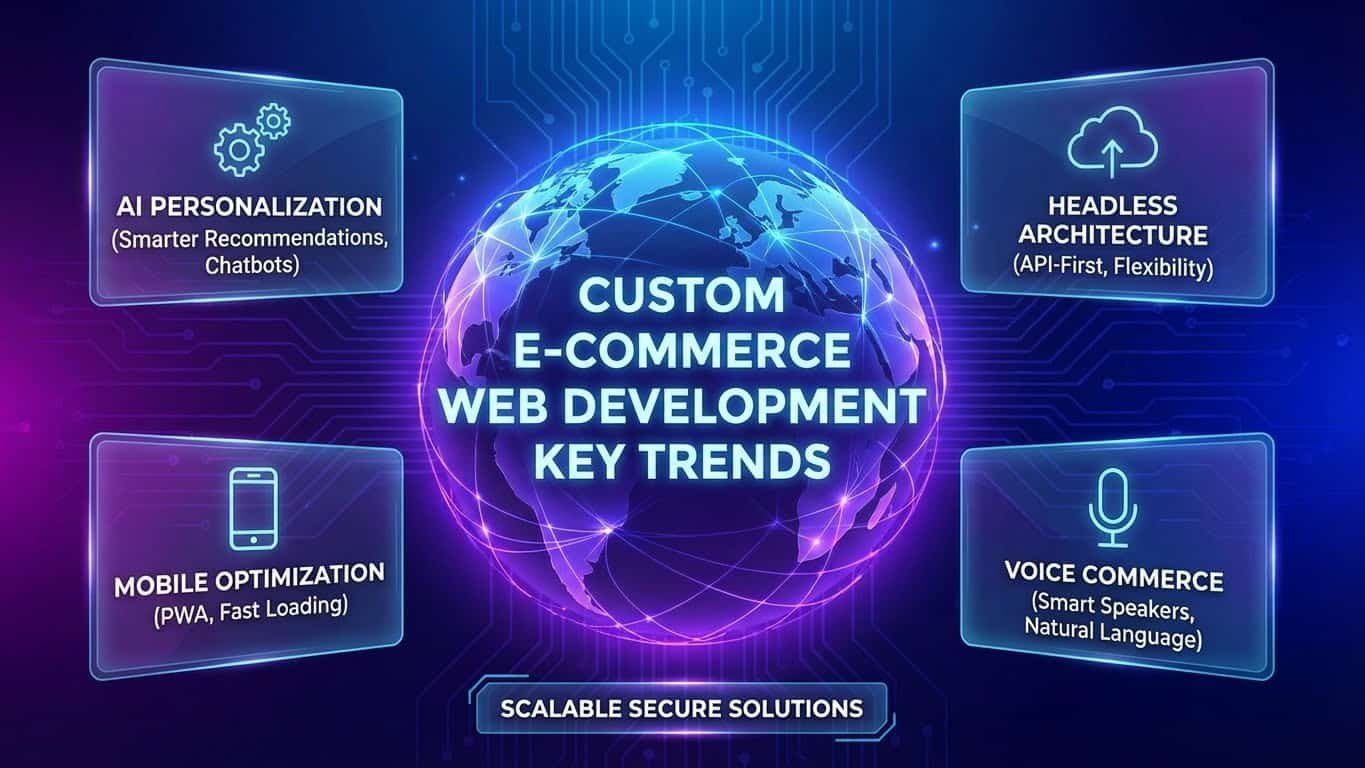
Custom E-commerce Web Development Key Trends
The e-commerce market has transformed dramatically over the last decade—faster than almost any other digital industry. Consumer expectations have shifted, technology has evolved, and competition has grown exponentially. Generic e-commerce templates are no longer enough. Businesses now need custom e-commerce web development to deliver personalized experiences, scale efficiently, and stand out in a crowded marketplace.
According to global ecommerce revenue projections, online retail is expected to surpass $7.5 trillion by 2025, driven by mobile commerce, digital-first consumer behavior, and advanced online shopping experiences. In such a competitive environment, having a custom-built ecommerce platform is not a luxury—it’s a growth investment.
This comprehensive guide explores what custom ecommerce development means, core features you must include, modern technologies powering ecommerce, and the latest trends that are shaping the future of digital commerce. By the end, you’ll clearly understand how a custom ecommerce website can boost revenue, improve customer engagement, and strengthen brand authority.
What is Custom E-commerce Web Development?
Custom ecommerce web development is the process of building an online store tailored specifically to a business’s needs, rather than relying on pre-designed templates or limited platform features.
Instead of using one-size-fits-all layouts, custom ecommerce solutions allow developers to create unique UI, custom integrations, personalized features, and a seamless user experience based on buyer behavior and brand identity.
Custom vs Template-Based Ecommerce
| Template-Based Ecommerce | Custom Ecommerce Development |
|---|---|
| Faster to deploy but limited features | Fully personalized features & UI |
| Difficult to scale for large stores | Scalable for future expansion |
| Looks similar to competitors | Unique brand experience |
| Fixed layouts & functionalities | Complete design freedom |
| Restricted integration options | Integrates with CRM, ERP, POS & 3rd-party tools |
If you want an ecommerce store that grows with your business—not against it—custom development offers flexibility, scalability, and long-term ROI that templates can never match.
Benefits of Custom Ecommerce Development
1. Tailored User Experience for Higher Conversions
Custom ecommerce development enables a seamless, intuitive shopping experience optimized for your target audience. From homepage layout to product navigation—every detail is built to convert visitors into buyers.
Personalized experience = longer browsing time
Better navigation = higher sales & lower bounce rate
2. Scalability for Future Growth
As your business grows, so will traffic, inventory, and technical demands. Custom ecommerce platforms allow scaling without limitations—new features, product variations, user roles, or marketplace conversion can be added effortlessly.
3. Lightning-Fast Performance & SEO Boost
Search engines reward fast-loading ecommerce sites. Custom-built stores use optimized code, efficient databases, and caching algorithms—resulting in better rankings and more organic traffic.
✔ Faster pages = Higher visibility
✔ Better UX = Increased cart conversions
4. Strong Security Architecture
With cyberattacks rising globally, ecommerce security is non-negotiable. Custom development enables strong authentication methods, secure payment integrations, firewalls, and encrypted data protection.
5. Integration Flexibility
Custom ecommerce systems easily integrate with:
- CRM Platforms (HubSpot, Zoho, Salesforce)
- ERP & Inventory Systems
- POS Billing Tools
- AI Recommendation Engines
- Marketing Automation Software
- Third-party Logistics & Shipping APIs
This connectivity streamlines operations and reduces manual workload.
Essential Features Every Custom E-commerce Store Must Have
To thrive in today’s marketplace, your e-commerce platform needs more than just product listings.
Here are the 10 critical features that define modern ecommerce excellence:
1. Mobile-First Responsive Design
More than 70% of shoppers buy through mobile, making responsive UI the foundation of e-commerce success. A mobile-optimized layout ensures smooth navigation, fingertip-friendly buttons, and a frictionless checkout experience.
2. Intelligent Product Filtering & Smart Search
Buyers want to find products fast. Smart filters using attributes like brand, size, color, price, and reviews improve product discovery. AI-powered search can understand typo-tolerant queries like “blu t-shert” and still return the right product.
3. Personalized Product Recommendations
AI-driven recommendations increase sales by suggesting products based on customer behavior, purchase history, and browsing patterns.
Dynamic recommendation engines can boost revenue by 28–35%.
4. Secure & Reliable Payment Integration
Support for credit cards, PayPal, Stripe, Apple Pay, Google Pay, and local gateways helps build trust and reduce cart abandonment.
5. Multi-Language & Multi-Currency Support
If you serve global buyers, localization is essential. Regional currency, language translation, and tax configuration allow international expansion.
6. One-Click Checkout & Auto-Fill Forms
A fast checkout reduces cart abandonment significantly. Autofill, guest checkout, saved addresses, and digital wallet options enhance speed & convenience.
7. Automated Inventory & Order Management
Custom automation reduces manual errors, syncs product stock in real-time, and streamlines order fulfillment—especially for large stores.
8. Wishlist, Product Compare & Review System
These features increase engagement, improve user research ability, and encourage repeat visits.
9. Email & Marketing Automation Tools
Integrate with platforms like Klaviyo, Mailchimp, and Omnisend for:
- Cart abandonment emails
- Upsell/cross-sell campaigns
- Flash sale broadcasts
- Customer lifecycle nurturing
10. Live Chat & AI Chatbots
Real-time customer support builds trust and converts hesitant buyers. AI chatbots handle FAQs 24/7 boosting retention & handling support cost-efficiently.
Technologies Powering Custom E-commerce Development
Modern e-commerce systems rely on powerful, scalable tech stacks. Here’s a breakdown of the most used technologies:
Frontend Frameworks
- React.js – fast, modular & scalable UI
- Next.js – ideal for SEO & server-side rendering
- Vue.js – lightweight & flexible
- Angular – enterprise-grade architecture
Backend Technologies
- Node.js – event-driven & scalable
- Laravel (PHP) – secure & structured
- Django (Python) – rapid development & built-in security
- Ruby on Rails – fast prototyping & elegant architecture
Databases
- MySQL / MariaDB – structured & highly reliable
- MongoDB – ideal for flexible product catalogs
- PostgreSQL – secure and high-performance
- Firebase – real-time data sync
CMS & Headless Ecommerce
- Shopify + Shopify Hydrogen
- Magento (Adobe Commerce)
- WooCommerce (WordPress)
- BigCommerce Headless
- Custom Headless API Architecture
Headless commerce separates frontend from backend—offering unmatched performance and flexibility.
Cloud Hosting & Deployment
- AWS & Google Cloud for large-scale setups
- DigitalOcean & Cloudways for SMBs
- Vercel/Netlify for frontend hosting
This modern infrastructure ensures speed, security & uptime reliability.
Custom E-commerce Web Development Key Trends
1. Headless Commerce Architecture
Headless commerce enables lightning-fast performance, multi-channel delivery, and personalized UX. It’s the future of scalable ecommerce.
2. AI & Machine Learning Personalisation
AI analyzes user behavior to deliver personalized recommendations, dynamic pricing, and chat-based shopping support.
3. Voice Search & Conversational Shopping
Voice-enabled search is growing rapidly thanks to Alexa, Google Assistant & Siri. Optimizing e-commerce voice commands helps brands stay future-ready.
4. AR/VR Try-On Experiences
Augmented reality lets customers virtually test furniture, fashion, or cosmetics before buying—reducing product returns and increasing confidence.
5. Blockchain & Crypto Commerce
Blockchain improves payment transparency, logistic tracking, and fraud defense. Crypto transactions are becoming more accepted.
6. PWAs (Progressive Web Apps)
PWAs behave like mobile apps without installation—fast, offline-capable & highly engaging.
7. Subscription Commerce
Brands are increasingly using subscription models for food, beauty, software, and household essentials—ensuring recurring revenue.
8. Social Commerce Boom
Users now buy directly from TikTok, Facebook, Instagram & YouTube—blending content + commerce seamlessly.
How Custom Ecommerce Stores Drive Growth
A professionally built ecommerce platform directly impacts revenue and brand visibility.
✔ Better UX → More conversions
✔ Faster pages → Higher SEO rankings
✔ AI personalization → Increased repeat purchases
✔ Automation → Lower operational cost
✔ Brand differentiation → Competitive advantage
Custom ecommerce websites do not just sell products—they build experiences that turn visitors into loyal customers.
Cost of Custom E-commerce Development
Pricing depends on complexity, features, technology stack, and the development team’s expertise.
Estimated Cost Range
| Store Type | Estimated Budget |
|---|---|
| Small Business Store | $5,000 – $15,000 |
| Medium Scale (500–5000 products) | $15,000 – $60,000 |
| Enterprise Ecommerce System | $60,000 – $250,000+ |
Maintenance, hosting, security updates, and feature upgrades also require ongoing investment.
A template may be cheaper initially, but custom development delivers long-term scalability, better UX & higher ROI.
Choosing the Right E-Commerce Development Partner
Before hiring an agency or developer, evaluate:
What to check before hiring:
- Strong e-commerce development portfolio
- Expertise in your required technologies
- Ability to scale systems for future growth
- Knowledge of UI/UX & user psychology
- Transparent pricing & realistic timelines
Questions to ask:
- Which framework do you recommend for my needs?
- Will my store support AI, automation & multi-currency?
- How do you ensure performance & security?
- What post-launch support do you provide?
Strong technical expertise + real-world ecommerce understanding = guaranteed success.
Conclusion
Custom ecommerce development is more than building an online store—it’s creating a scalable growth machine. With tailored UX, advanced features, modern technologies, and future-ready trends like AI & headless commerce, brands can compete confidently in a fast-evolving digital market.
Whether you’re launching a new ecommerce business or upgrading an existing store, investing in custom development ensures long-term ROI, better performance, and an exceptional shopping experience that keeps customers coming back.
1. What is custom e-commerce web development?
Custom ecommerce web development refers to building an online store from scratch with personalized features, design, and integrations tailored to business needs.
2. Why choose custom e-commerce over templates?
Templates are limited, while custom development offers scalability, unique UX, advanced integrations, and long-term performance benefits.
3. How long does custom e-commerce development take?
A standard custom ecommerce store can take 6–16 weeks, depending on features, product volume, and complexity of integrations.
4. What technologies are best for e-commerce development?
Popular tech stacks include React, Next.js, Node.js, Laravel, Django, Shopify, Magento, WooCommerce, and Headless Commerce frameworks.
5. How much does custom e-commerce development cost?
Pricing generally ranges between $5,000 and $250,000+ depending on scale, technology stack, UI/UX, and required custom functionalities.
6. Is a custom e-commerce website SEO-friendly?
Yes. Custom ecommerce sites allow optimized page speed, structured data, mobile-first design, and clean code—all improving organic rankings.
7. Can AI be integrated into e-commerce websites?
Absolutely. AI is now widely used for personalized product recommendations, chatbots, pricing automation, customer behavior analysis, and upselling.
8. What features are most important for modern e-commerce?
Must-have features include fast checkout, mobile-responsive UI, secure payment gateways, product search, analytics dashboards, and automated inventory systems.
9. How secure is custom e-commerce development?
Security is highly customizable—SSL encryption, firewalls, fraud detection, 2FA, secure payment gateways, and regular code audits ensure strong protection.
10. What is Headless Commerce and why is it trending?
Headless commerce separates frontend and backend for greater speed, flexibility, and multi-channel experiences—ideal for scalable future-proof ecommerce growth.